
In multimodal transport the overload is the point where the road, rail, sea or air leg must connect without time loss and without damage to the cargo. A delayed goods unit may miss a train, ship or pre-booked vehicle and disrupt the entire schedule.
It is important to distinguish the transfer of a full container or swap body from the physical handling of pallets, crates, industrial roles or machines. In the second case every additional lift increases time, required equipment and risk.
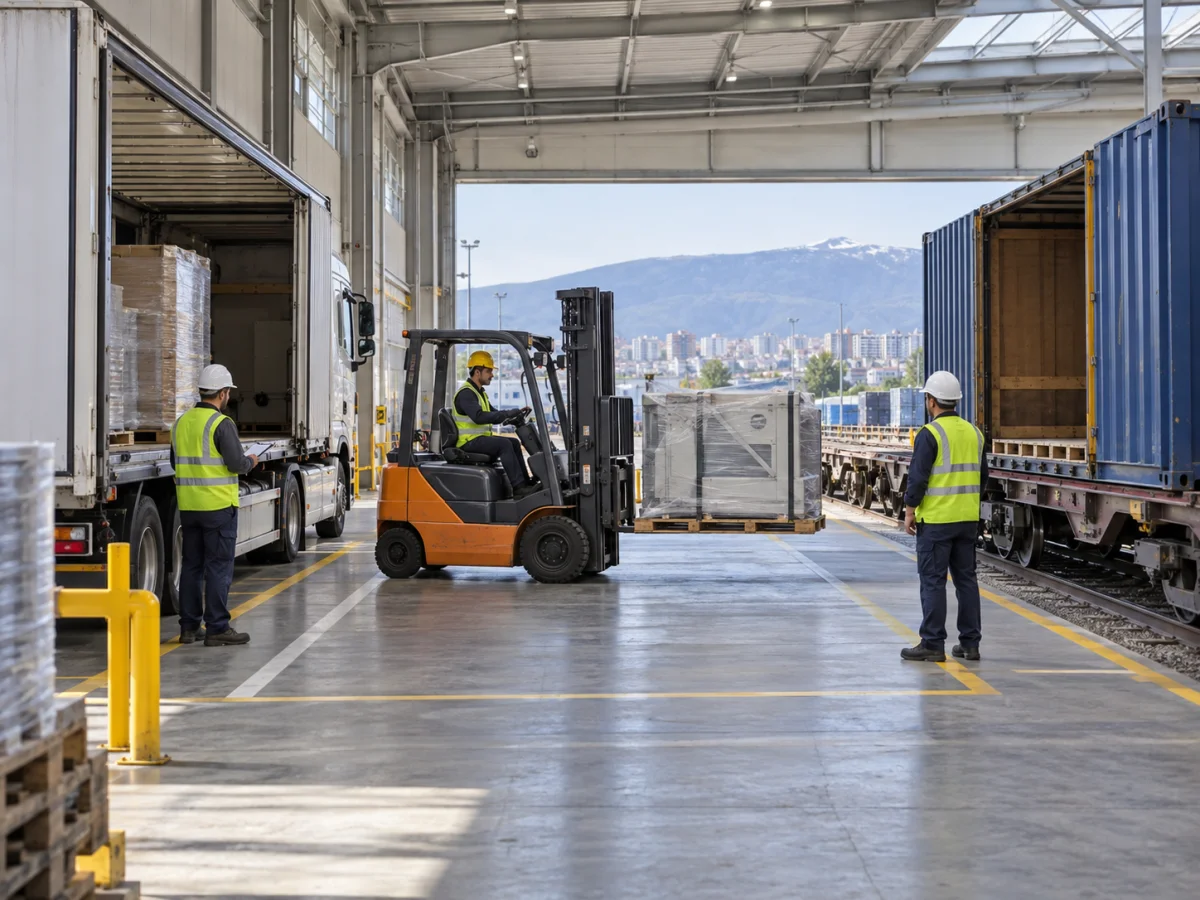
Map of freight operations before route selection
Before comparing routes, describe each transfer point: incoming vehicle, terminal or warehouse, unloading method, possible dwell time, next mode of transport and final loading. This makes clear whether a closed transport unit is transferred or the goods themselves are processed.
- dimensions, gross weight and number of freight units;
- center of gravity, lifting points and permissible orientation;
- condition of the pallet, crate or other transport packaging;
- required equipment, working radius and permissible floor load;
- deadline for processing and connection with the next departure.
A route with one additional operation may look faster on the map, but be riskier if the terminal lacks suitable equipment or if there is no realistic buffer between arrival and departure.
Reducing the number of physical movements
When the goods remain in a container, swap body or other intermodal equipment, when changing the type of transport the entire unit is moved. This reduces physical handling of the goods. The European Commission defines the intermodal approach precisely as a combination of transport modes, in which a larger part of the route may be rail, water or sea transport, and the truck serves the initial and final leg.
When physical reloading is inevitable, cross-docking is more suitable than intermediate storage if the outgoing vehicle and documents are ready. Pallets and crates are pre-grouped by next destination, and labels are placed so they can be scanned without shifting.
Costs of dwell time, handling and missed connection
The unloading or loading fee is only one component. The total cost includes dwell time of the truck or container, warehouse space, repackaging, extra lifting equipment, additional securing and possible damage. When missing a train or ship a new terminal dwell time and rescheduling can be added.
Therefore the lowest unit handling price is not necessarily the lowest logistic cost. More expensive, but pre-booked operation with ready equipment can prevent days of dwell time.
For calculating the entire operation, not just a single lift, send an inquiry with the route, freight units and time windows.
Coordination of terminal, warehouse and equipment
Lift capacity is the first, but not the only check. The working height, fork length, center of gravity, required grip, crane radius, covered area and the possibility for different vehicles to stand safely are important.
In A Logistics’ logistics base in Sofia, forklifts with load capacities of 2.5 t, 5 t and 8 t, forks length 2.4 m, two industrial crate clamps, 5 t hoist and a crane with capacity up to 20 t have been confirmed. Nominal capacity does not replace technical check: for the specific cargo the size, working radius, base area, center of gravity and accessibility are evaluated.
Time windows and cross-docking plan
Cross-docking works only when the incoming and outgoing flows are synchronized. The practical sequence is:
- advance notice with expected time, registration and freight units;
- reserved slot, free zone and ready lifting equipment;
- checking seals, documents, quantity and packaging;
- direct distribution to the designated outbound area;
- confirmation for reloading and handover to the next stage.
A short buffer is useful when the incoming stage may be delayed, but the next departure is fixed. Too early arrival without ready outgoing transport simply turns cross-docking into paid storage.
Packaging and securing for all transport stages
Packaging is designed for the entire route: vibrations on the road, lifting with forklift or crane, terminal handling and different directions of force. A pallet with a damaged plank can withstand a static dwell but break on a second lift.
Edges, gripping points, center of gravity markings, no-stacking rule and moisture resistance are checked. After every physical reloading the securing is restored for the next mode of transport. CTU Code of IMO, ILO and UNECE provides a practical framework for packaging and securing transport units for road and sea transport.
Documents and data before arrival
The warehouse or terminal must receive the data before the vehicle. The minimum operational package includes packing list, numbers and dimensions of the units, gross weight, registration or container number, seal numbers, next destination and handling instructions.
Applicable automotive, rail, maritime or air documents and customs documents for the regime are added. If the packing list states three crates, but four arrive physically, or if the seal does not match, the overloading must stop until clarification. This is safer than sending a non-conforming shipment to the next border or terminal.
Overloading control indicators
Control is based on measurable events, not on an overall assessment that the operation was “fast.” For each line you can monitor:
- the time from arrival to ready for departure;
- the number of physical moves of each unit;
- dwell time outside the booked time window;
- damages to packaging and discrepancies in unit count;
- missed connections and the reason for each of them.
Values are compared between successive shipments on the same line. This can help determine whether the problem comes from documentation, delayed incoming transport, unsuitable equipment or inefficient distribution in the area.
Organization of overloading by A Logistics
A Logistics organizes overloading, cross-docking, temporary storage and subsequent transport through its base in Sofia. For a specific scheme indicate the types of transport, all route connections, addresses and time windows, dimensions and weight, packaging, center of gravity, required equipment, customs status and deadline.
For operation plan and a personalized offer request a consultation.