
Freight transport between Bulgaria and Germany can involve a few pallets of production parts, a part load with reserved floor space or an entire truck for one consignee. Postcodes matter from the initial enquiry: delivery to a factory near Munich and delivery to a terminal in Hamburg require different mileage and schedules.
A Logistics arranges transport from Bulgaria to Germany and in the opposite direction. The choice between groupage, part-load and full-load delivery depends on the shipment’s dimensions and weight, whether transshipment is permitted and the agreed receiving deadline.
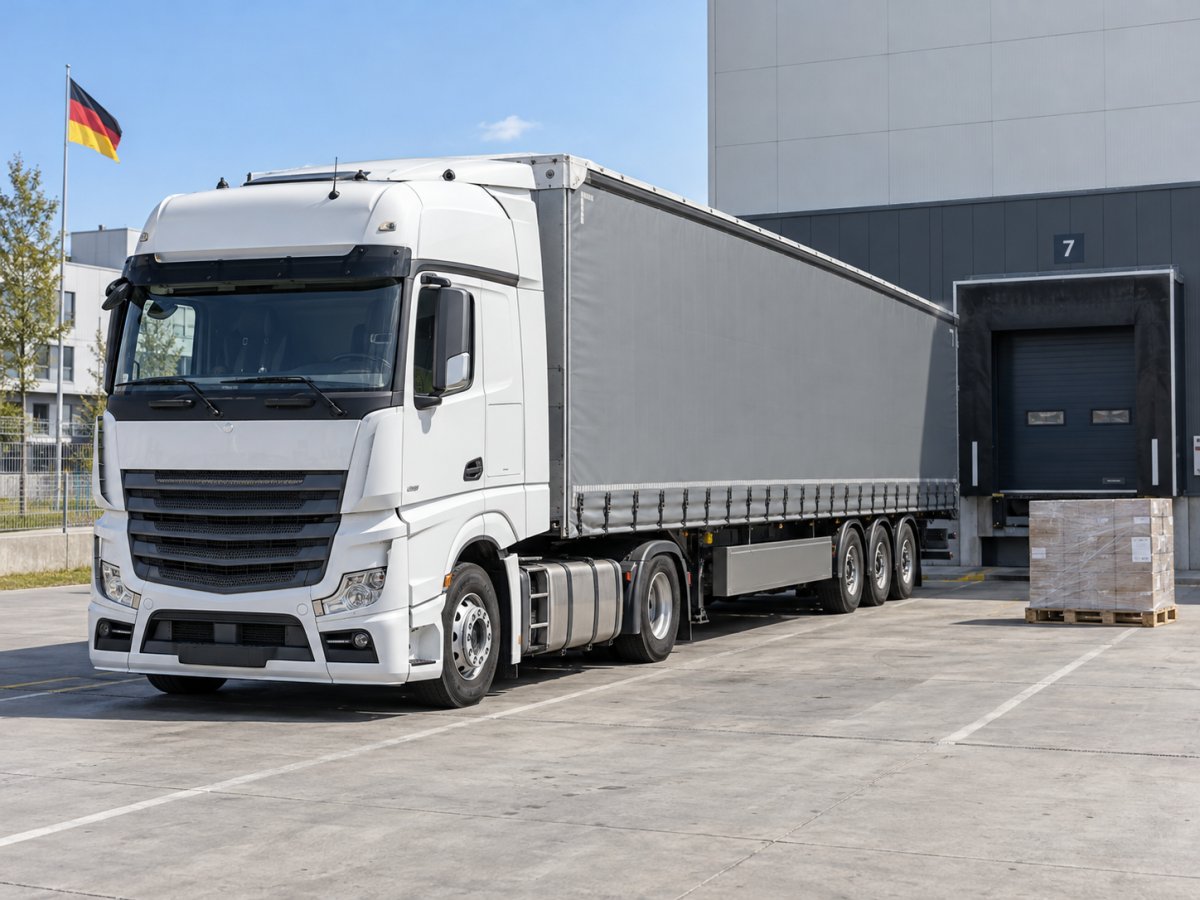
Groupage, part-load and full-load deliveries
Groupage combines small shipments from different shippers for a shared journey. For example, two pallets of spare parts can be consolidated with other cargo and then distributed to their respective consignees. Appropriate packaging, identification of every unit and suitability for terminal handling are important.
A part load occupies some of the vehicle’s capacity but does not necessarily pass through the same terminal network as small groupage shipments. A consignment occupying several loading metres may require direct loading and compatible additional cargo. The number of transshipments and collection or delivery addresses must therefore be agreed in the quotation, not inferred solely from the service name.
With a full load, the vehicle is reserved for one customer, even when the cargo does not fill its entire volume. This allows the schedule to be aligned with a particular production loading bay. Non-stackable crates, pallets of different heights and side-loading requirements affect usable capacity independently of total weight.
Cost of freight transport between Bulgaria and Germany
A quotation needs the exact collection and delivery postcodes, number of handling units, their external dimensions and gross weight. For a part load, the length of floor space occupied is also assessed. A pallet that cannot support other goods reserves more usable space than a stackable pallet of the same weight.
For groupage, the price covers the particular shipment and handling arrangement; for a part load, the required capacity and route; and for a full load, the dedicated vehicle. Additional agreed services may include a tail lift, another address, a fixed loading-bay appointment or waiting time. A general rate per kilometre does not capture these differences and is insufficient for comparing quotations.
For a specific price, send an enquiry with the postcodes, dimensions, gross weight and delivery deadline.
Distances and indicative delivery times
The following approximate mileages are route-planning references from Sofia via Niš, Belgrade, Budapest, Vienna and Passau to each city. This is one defined road option, not necessarily the shortest for every address. Distances are rounded to the nearest 10 km; the particular industrial estate and heavy-vehicle approach may change the mileage.
- Munich: approximately 1470 km; around 23 hours of driving; allow 3 working days for a direct journey and 5–7 working days for groupage.
- Stuttgart: approximately 1700 km; around 26 hours of driving; 3–4 working days for a direct journey and 5–7 working days for groupage.
- Frankfurt am Main: approximately 1740 km; around 27 hours of driving; 3–4 working days for a direct journey and 5–7 working days for groupage.
- Duisburg: approximately 1980 km; around 30 hours of driving; 4–5 working days for a direct journey and 6–8 working days for groupage.
- Hamburg: approximately 2120 km; around 33 hours of driving; 4–5 working days for a direct journey and 6–8 working days for groupage.
- Leipzig: approximately 1760 km; around 27 hours of driving; 3–4 working days for a direct journey and 5–7 working days for groupage.
Driving hours are a calculation based on an average of approximately 65 km/h, not a real-time navigation forecast. The stated days are planning estimates, not a confirmed A Logistics schedule or delivery commitment. They assume one driver, standard cargo, available capacity, normal border crossings and no exceptional restrictions; groupage also includes additional collection and distribution arrangements.
Delivery time cannot be calculated on the assumption of uninterrupted driving. Under the European driving and rest-time rules, daily driving is normally limited to 9 hours, extendable to 10 hours twice a week, and at least a 45-minute break is required after 4.5 hours of driving unless a rest period begins. A Sunday driving ban, missed receiving appointment or weekly rest period can extend delivery beyond these estimates.
Main routes and transport options
- Via Serbia, Hungary and Austria: Sofia–Kalotina/Gradina–Niš–Belgrade–Horgoš/Röszke–Budapest–Hegyeshalom/Nickelsdorf–Vienna–Passau–Munich, approximately 1470 km. The indicative direct transport time is 3 working days. Long motorway sections facilitate driving, but the route crosses the EU external border twice and the applicable transit procedure through Serbia must be prepared. Waiting at Gradina or Horgoš may affect the schedule.
- Entirely within the EU via Vidin–Calafat: Sofia–Botevgrad–Vidin–Calafat–Craiova–Drobeta-Turnu Severin–Timișoara–Nădlac/Csanádpalota–Budapest–Vienna–Salzburg–Munich, approximately 1670 km. Allow 3–4 working days for a direct delivery. This option avoids taking Union goods outside the EU but includes more non-motorway sections and the New Europe Bridge crossing. The distance and temporary restrictions on the Bulgarian and Romanian approaches must be assessed together, rather than relying only on the presence of internal Schengen borders.
- Southwestern option via Croatia and Slovenia: Sofia–Kalotina/Gradina–Belgrade–Batrovci/Bajakovo–Zagreb–Ljubljana–Karawanks Tunnel–Villach–Salzburg–Munich, approximately 1350 km. The indicative direct journey time is 2–3 working days under normal conditions. For Bavarian addresses it may be shorter than the route via Budapest and Passau, but transit through Serbia still applies, with additional Alpine tunnels, tolls and sensitivity to winter conditions and Austrian restrictions. It is not automatically the better choice for northern Germany.
All mileages refer to the stated endpoint, Munich. For another German city, the complete alternatives must be compared again. For loading in northern Bulgaria, Ruse–Giurgiu can also be considered, but this approach does not have the same mileage as departure from Sofia via Vidin.
A rail or intermodal arrangement makes sense when the loading unit is suitable and a terminal connection has been confirmed. The existence of a rail terminal in Germany does not itself mean that a direct train from Sofia is available or that a few pallets will arrive sooner; specific terminals, acceptance deadlines and prices for the road legs at both ends are needed.
Transport infrastructure and specific conditions in Germany
Munich and Stuttgart are important destinations for manufacturing supplies and the automotive industry; the A8 corridor is relevant for Stuttgart. Frankfurt am Main serves the Rhine-Main area through the A3 and A5. Duisburg is a gateway to the Ruhr, combining road, rail and inland-waterway terminals on the Rhine. Hamburg connects maritime container terminals with road and rail transport inland. Leipzig/Halle is a warehousing and air-cargo hub near the A9 and A14.
At a seaport or rail terminal, the receiving appointment and readiness of the container or loading unit are separate conditions from the truck’s arrival in the city. An intermodal delivery also requires checks on current rail restrictions along the specific route and the terminal’s ability to accept the chosen unit type.
German road tolls cover vehicles intended or used for freight transport with a technically permissible maximum laden mass above 3.5 tonnes, subject to applicable exemptions. For vehicle combinations, the towing vehicle’s mass is important. The current scope is explained by Toll Collect; transport costs are not determined solely by mileage within Bulgaria.
For commercial freight transport, the German Sunday and public-holiday driving ban generally applies from 00:00 to 22:00 to trucks over 7.5 tonnes and trailers behind trucks, with specified exemptions. Some holidays apply only in particular federal states. In July and August, additional Saturday restrictions from 07:00 to 20:00 apply on certain sections. Loading on Friday therefore does not necessarily mean delivery on Monday morning.
Roadworks and lane restrictions must also be checked for the day of travel. The official Autobahn GmbH traffic notices can be filtered by motorway and federal state. For routes using the A3, A8 and A9, the assessment must cover not only delays on the main road but also whether diversions are suitable for the vehicle’s dimensions and mass.
Documents, transit and receiving conditions
- An international road consignment note (CMR) with accurate shipper, consignee, loading and unloading details.
- An invoice or other goods-movement document and a packing list showing unit quantities, markings and weights.
- Handling instructions, including any prohibition on stacking, lifting points or side-unloading requirements.
- A confirmed receiving time, booking reference where required and consignee contact.
- Additional documents for dangerous, excise, non-Union or other regulated goods according to the applicable procedure.
When Union goods move entirely within the EU, ordinary import customs clearance does not arise merely because a border between Bulgaria and Germany is crossed. This does not remove tax, statistical or special requirements for the particular goods.
When travelling through Serbia, the appropriate transit procedure must be arranged. Serbia participates in the common transit system, which facilitates movements across different customs territories. Documentation and guarantees depend on the goods’ status and chosen procedure; the CMR consignment note does not replace them.
A consignee without a forklift must confirm the unloading method in advance. A tail lift must be requested with the unit’s permitted weight and dimensions and a suitable surface for moving it. For return transport from Germany, the readiness of the goods and documents to be provided to the driver must also be established.
Arranging transport with A Logistics
A Logistics offers groupage, part-load and full-load transport between Bulgaria and Germany, as well as warehouse handling in Sofia when needed. The order sets out the loading method, permitted handling operations, final address and receiving conditions. For a non-standard crate or machine, photographs supplement the dimensions and show limitations affecting lifting and securing.
To select a transport arrangement and confirm the delivery time, send an enquiry with the addresses, cargo specifications and ready date.